Quick answer: No. Shock wave outcomes depend on how precisely the device delivers energy to the target tissue: the energy flux density, the number of pulses, the focal depth, and the accuracy of targeting. The size of the machine doesn’t determine results. Lightweight, battery-powered focused devices can deliver clinically meaningful treatment without the bulk.
Key takeaways
- The biological effect of shock wave therapy depends on the dose: energy flux density (EFD, in mJ/mm²) multiplied by the number of pulses.
- There is a minimum effective energy level and an upper threshold at which tissue damage begins. Precision matters more than raw power.
- Focused shock waves concentrate energy at a chosen depth. Radial pressure waves spread outward and are a different technology.
- The energy levels used in published canine osteoarthritis protocols fall within the range of today’s handheld focused devices.
Why do people assume bigger means better?
In the video above, Dr. Tom Walsh addresses the assumption that a device has to be bigger and heavier to be stronger. It’s an understandable instinct. Early veterinary shock wave systems were cart-mounted generators. One system described in the dvm360 proceedings on shock wave therapy for osteoarthritis had a generator weighing 16 kg. When the only effective devices looked like that, size and effectiveness seemed to go together.
What determines shock wave treatment quality?
The answer is dose and delivery. dvm360 proceedings on shock wave therapy explain that the biological effect depends on energy flux density (EFD, in mJ/mm²) multiplied by the number of pulses. There is a minimum effective EFD below which little happens, and a higher level at which tissue damage begins. Good treatment stays within that window at the right tissue depth.
That leaves three variables that matter:
- Energy flux density. Is the device delivering a therapeutic energy level at the focal point?
- Focal depth. Can you place that energy at the depth of the target structure, whether a superficial tendon or a deeper joint?
- Targeting. Is the energy concentrated where you need it, or spread across surrounding tissue?
A Today’s Veterinary Practice review of rehabilitation modalities notes that shock wave devices differ in penetration depth and focal area. These are key specifications to compare in addition to device size and weight differences.
Is focused shock wave different from radial?
Yes, and the difference affects results more than size does. The Clinician’s Brief review of shock wave therapy explains that focused shock waves converge at a focal point within the tissue, whereas radial pressure waves spread from the applicator. The dvm360 proceedings add that radial waves have slower rise times and lower peak pressures than true shock waves. When you compare devices, first confirm whether a unit produces focused shock waves or radial pressure waves.
How does a handheld device compare in terms of numbers?
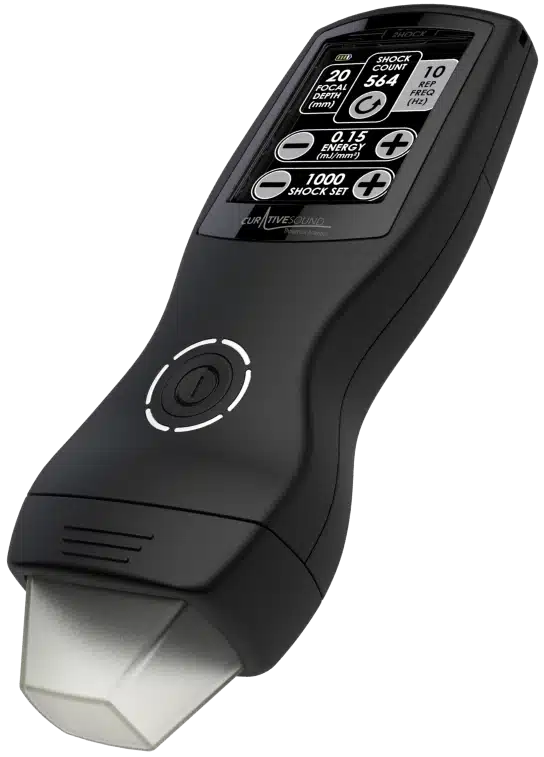
The dvm360 osteoarthritis proceedings describe canine protocols using approximately 0.11-0.15 mJ/mm² on a large electrohydraulic system. The handheld CS-Pro VET covers an EFD range of 0.02 to 0.22 mJ/mm², so those published levels fall within its range. It offers selectable focal depths of 2, 5, 10, 20, and 30 mm, as well as a therapeutic volume of more than 1,000 mm³. The device weighs only 14.5 ounces.
Focal depth still matters. Choose the depth setting that matches the anatomy you are treating, and consider whether a very deep target is within a device’s reach. For most small-animal tendons, joints, and soft tissues, precise focal targeting is what drives the result.
What does a lighter device change clinically?
- Treatment goes to the patient. You can treat in any exam room, cage-side, or on a farm call.
- Better positioning. A handpiece you can hold steadily makes accurate targeting easier.
- Consistent delivery. Swappable batteries delivering up to 100,000 shocks per charge let you finish a full treatment without a power cord tethering you.
- Lower barrier to adoption. There’s no dedicated room, cart, or capital-equipment footprint.
If you’re evaluating devices, our veterinary shock wave device checklist walks through the specifications to ask about.
See the CS-Pro VET in your practice. Handheld, battery-powered focused shock wave therapy for small animal and equine patients.