Quick answer: Not with modern focused piezoelectric systems. Traditional shock wave generators produce a loud, sharp crack that has historically led to the use of earplugs by staff and patients. Current handheld piezoelectric units are quiet enough to use in a regular exam room without hearing protection, which leads to calmer patients and easier sessions.
Key takeaways
- Traditional shock wave generators produce a loud, ballistic sound, and hearing protection is recommended when using them.
- Noise matters clinically: large studies show that a substantial share of dogs fear sudden or loud sounds.
- Sensitivity to noise increases with age, which overlaps with the senior osteoarthritis patients who benefit most from shock wave therapy.
- The CS-Pro VET is rated at 55 dBA at a distance of half a meter, well below the levels associated with hearing damage.
Why do people think shock wave therapy is loud?
Because it used to be, older reviews in Clinician’s Brief and dvm360 described traditional shock wave treatments as very loud, and that noise was one reason sedation was routine. A review as recent as 2025 in Veterinary Practice News describes the sound of these units as loud and ballistic. It recommends earplugs for both staff and patients, especially in rooms with hard, reflective surfaces. The same review cautions that rhythmic sounds may trigger reactions in some patients.
If your only experience with shock wave therapy involves a dedicated treatment room and a box of earplugs, the myth makes sense. It just doesn’t describe current piezoelectric technology.
Why does treatment noise matter for patient care?
Noise isn’t only a comfort issue for staff. It’s a patient welfare issue that affects how well a patient accepts treatment.
- A dvm360 report on the Dog Aging Project, covering more than 43,000 dogs, found that 42.9% showed at least mild fear of sudden or loud sounds. Nearly 10% reacted at the most extreme level.
- Clinician’s Brief reports that noise hypersensitivity affects roughly 14% to 32% of dogs. Dogs hear sounds about 4 times farther away than people do and are especially sensitive between 3,000 and 8,000 Hz.
- The same Clinician’s Brief article notes that the odds of noise fear increase by about 3.4% per year of age. That matters because senior patients make up a large share of the shock wave caseload.
- Cats are affected too. A dvm360 journal scan of 96 cats with sound-triggered seizures found an average age at onset of 15 years. Every day sounds such as crinkling foil and keyboard clicks, were common triggers.
A patient who is frightened by a device is harder to position and treat, and is less likely to return calmly for the second and third sessions.
How quiet is a modern piezoelectric system?
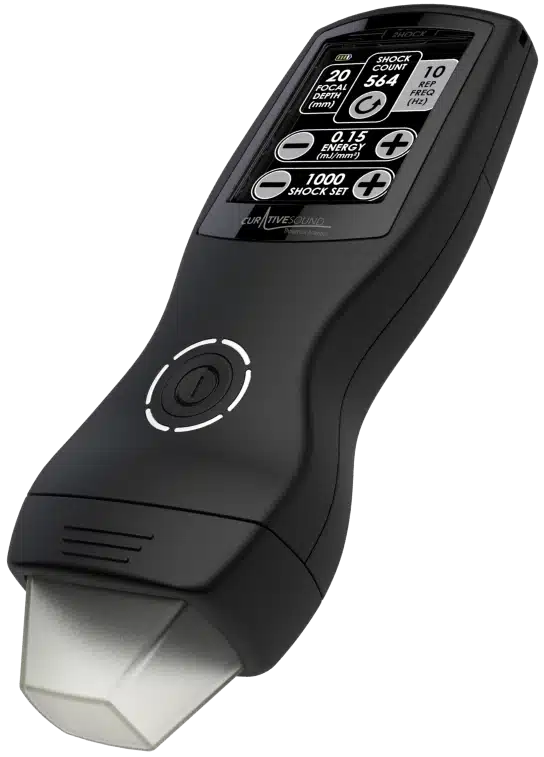
In the video above, Dr. Tom Walsh explains that modern piezoelectric systems are quiet enough for regular exam rooms: no earplugs for the veterinarian, the technicians, or the patient. The CS-Pro VET measures just 55 dBA at 0.5 meters.
For context, dvm360 proceedings on sound in the veterinary workplace note that hearing damage becomes a concern with prolonged exposure above 85 dB. Decibels are logarithmic, so 55 dBA is far quieter than those thresholds.
What does a quieter device change in daily practice?
- No dedicated room. Treatments can happen in any exam room or cage-side.
- Owners can stay. A familiar person nearby helps many patients settle.
- No hearing protection. Technicians can talk to and reassure the patient throughout the session.
- Easier scheduling. Short, calm sessions fit into a standard appointment block rather than a separate treatment slot.
As Dr. Walsh puts it in the video, sessions are calm, well-tolerated, and fit right into a busy day.
See the CS-Pro VET in your practice. Handheld, battery-powered focused shock wave therapy for small animal and equine patients.